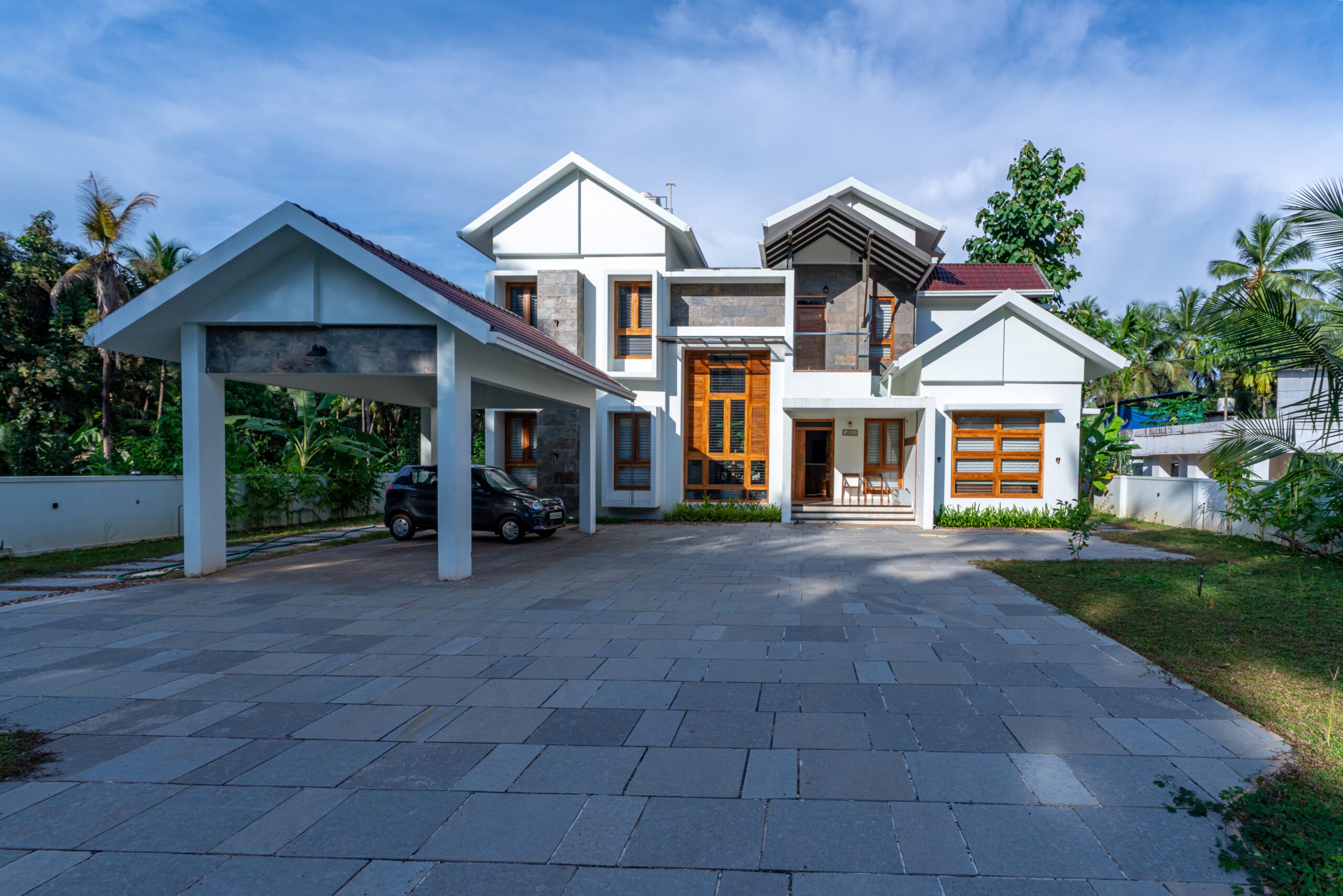
Smart Home Interior Design in India: Ideas for Modern Living 2026
The house that will be considered smartest in 2026 won’t be the one with the most devices. Rather, it is the one that will not have any device at all for everyone to see.
This is the subtle revolution in Indian residential architecture. The era of visible technology — cable conduits snaking along walls, routers sitting awkwardly on bookshelves, a dashboard of app icons just to turn on your lights — is ending. What’s replacing it is something far more sophisticated: a home that anticipates your needs, responds to India’s demanding climate conditions, and looks, from the outside, like simply beautiful interior design.
For the NRI engineer in Silicon Valley building a villa in Calicut. For the tech worker in Bangalore residing in an apartment of 1,200 square feet who desires to have a seamless morning experience. For the joint family in Hyderabad with senior citizens in the house who need security without a sterile approach. For the eco-conscious minimalist watching their electricity bill spike every summer.
Smart home interior design in India in 2026 isn’t one product. It’s a design philosophy — and this is what it looks like in practice.
The 2026 Turning Point: Why the Matter Protocol Changes Everything
A smart home in India was a gamble until very recently because there were only a few ecosystems in the market from which one could pick one to build their ecosystem. These included Google Home, Amazon Alexa, Apple HomeKit, or an indigenous Indian one. Five apps. Incompatible devices. A system that partially worked, constantly needed troubleshooting, and aged poorly.
2026 is the year that ends.
The Matter protocol, a universal smart home compatibility standard supported by the likes of Apple, Google, Amazon, Samsung, and more than 550 other brands, has hit critical adoption mass in India. The devices that support the Matter protocol have the same language, irrespective of their brands. It means that you can use Philips smart lighting systems, Yale smart locks, Daikin smart air conditioners, Somfy smart curtain systems, and others, using just one interface.
As an interior designer specializing in designing integrated smart homes in India, I can say that this technology will shift the discussion entirely in favor of the experience of the occupants rather than the products themselves. It means that we will design based on the needs of people and then choose the product with the required function. This interoperability is at the core of any smart home choice in 2026.
The Indian Factor: Climate-Responsive Smart Design
Here is where global smart home design guides consistently fail the Indian homeowner. A smart home designed for San Francisco has no meaningful answer to a Kerala monsoon, a Mumbai summer, or a Delhi winter fog alert.
Climate-responsive technology is the defining differentiator of truly intelligent Indian home design — and it operates on three fronts.
1. Heat and Humidity Management
India’s tropical and subtropical climate creates conditions that standard smart home systems aren’t configured for. AI-driven climate control for Kerala homes and across India’s coastal belt now uses real-time humidity sensing alongside temperature data to manage ventilation intelligently. When outdoor humidity spikes above 80%, smart ventilation systems automatically shift to recirculated air cooling. When it drops after the monsoon, windows open on their own to flush the house with the cooler outdoor air — no human input required.
Circadian lighting – intelligent lights that automatically change color temperature from daylight-white during the morning to amber hues in the evening – makes the most sense in India, because the level of natural light outdoors is far greater in India than in Europe. Products such as Ketra and Lutron Athena make this automatic adjustment without any need for manual intervention.
2. Monsoon Automation
“Automated drapes and blinds” of the year 2026 are not only a luxury but rather an effective climate control system. In 2026, technologies of Somfy, Legrand, and Linak automatically deploy motorised exterior shades in case rain is identified to ensure that no water enters the building through the windows. When solar gain is high, the system angles louvres to block direct sun while preserving the view. This directly reduces the load on air conditioning — one of the largest contributors to electricity bills during Indian summers.
3. Energy Intelligence
The environmentally conscious homeowner will see that in India “energy-efficient smart homes” now monitor electricity use circuit by circuit. By using the smart meters available through platforms such as Schneider Electric’s Wiser system, one will see a detailed breakdown of exactly what appliances are consuming how much power, including “phantom” loads, and automatically create load shifting schedules for peak times.
Invisible Technology: The Aesthetics of Smart Design
This is the principle that separates a smart home from a gadget showcase — and it is the lens through which every best smart home designer in India should be evaluating every technology decision.
Every hub, every router, every control panel, every sensor is a potential design intrusion. The discipline of smart home interior design is largely the discipline of hiding these elements without compromising their function.
The False Ceiling as Infrastructure
In Indian residential design, the false ceiling is already a standard feature. In 2026, it has become the primary infrastructure layer for smart home integration. Mesh Wi-Fi nodes are recessed within ceiling cavities. Speaker arrays are flush-mounted behind acoustically transparent stretch ceiling panels. Lighting control dimmers are concealed in service voids.
Air quality sensors sit behind micro-perforated panels that are visually indistinguishable from decorative ceiling details.
What you see: a beautifully designed tray ceiling with warm cove lighting.
What’s inside: the entire nervous system of your home.
Custom Cabinetry as Technology Housing
Smart mirrors — displays integrated into full-length mirror panels in bedrooms and bathrooms that show weather, calendar, and news without disrupting the reflective surface — require precise cabinetry integration to look intentional rather than retrofitted. The same applies to charging drawers, router cabinets with ventilated backs, and entertainment walls where the television, soundbar, streaming unit, and network equipment are all housed in custom joinery designed so that not a single cable is visible from any angle.
For commercial interior design firms extending smart technology into boutique hospitality and premium retail in cities like Calicut, this level of tech-concealment cabinetry is now a baseline client expectation, not a premium option.
Voice Control Without the Speaker on Show
Voice-controlled interiors in the year 2026 will have progressed to the point where the microphone array, which listens all the time, can be anything but a cylindrical object made out of plastic, resting on your coffee table. Now, the far-field microphone array will be built into things like ceiling panels, picture frames, and wall-mounted devices.
Multi-Generational Smart Design: Technology for Every Generation
India’s joint family structure creates a unique design challenge that few global smart home guides address. The same home may house a 75-year-old grandmother who has never used a smartphone and a 12-year-old who can configure a network in twenty minutes.
Multi-generational tech design in 2026 addresses this through tiered interaction models. The same smart home system operates at multiple levels of complexity simultaneously:
● Physical switches: Traditional rocker or touch switches, still in their expected wall positions, still work exactly as before for family members who prefer them
● Voice control: For hands-free operation, the home responds to natural language commands without any app navigation
● App control: For those who prefer it, full system management through a single consolidated interface
● Automation: For the most tech-comfortable household members, scheduled routines, geofencing triggers, and conditional logic that runs the home proactively
For security-conscious families with elderly parents in independent living arrangements, IoT security integration delivers fall-detection sensors embedded in bathroom flooring, motion pattern analysis that alerts family members when a daily routine is broken, and one-touch emergency panels disguised as standard light switches — features that provide genuine peace of mind without making older family members feel monitored or medicalised.
What Does Smart Home Interior Design Cost in India in 2026?
One of the most searched questions — and one that deserves an honest answer.
Scope of Automation Approximate Cost Range
Smart lighting only (3-BHK) ₹2 – ₹5 lakhs
Smart lighting + climate control + security ₹6 – ₹15 lakhs
Full integrated smart home (3–4 BHK) ₹15 – ₹40 lakhs
Luxury smart villa (5BHK+, full automation) ₹40 lakhs – ₹1.5 crore+
Cost of smart home interior design in Bangalore, Chennai, Mumbai, and Calicut follows broadly similar brackets, with Tier-1 metros at the higher end due to labour costs and premium system demand. The largest variable is the choice between proprietary high-end systems (Crestron, Control4, Savant) and the increasingly capable mid-range Matter-compatible ecosystems that deliver 85% of the functionality at 40% of the cost.
The most important cost principle: smart infrastructure integrated during construction costs 30–40% less than retrofitting into a completed home. The time to invest in smart design is at the architectural planning stage — not after fit-out.
IAMA Architects: Where Smart Technology Meets Interior Craft
At IAMA Architects, we consider the designing of smart homes like any other project for residences in that the technology is meant to enhance the lives of the people living in it and not vice versa.
One of the top interior design companies in Calicut and with a growing number of clients in the country, we take the concept of smart homes into account during the process of architecture. Our team works alongside specialist technology consultants to ensure that every hub, sensor, and automation layer is invisible in the finished home, and that every system is specified for India’s specific climate, power conditions, and multi-generational household dynamics.
For our NRI clients building in Kerala from the GCC or the West, smart home integration also solves a practical problem: a home you can monitor, secure, and manage entirely from your phone — whether you’re in Calicut or California.
Interested in building a smarter home? Book an exclusive design consultation with our principal designer at our Calicut studio — or virtually, wherever you are in the world.
FAQs
1. What is smart home interior design and how is it different from regular interior design?
Interior design for smart homes is the integration of home automation technologies – lighting, climate control, security system, audiovisual entertainment, and access controls – into the interior design itself. As opposed to adding home automation equipment to a completed interior space, smart home interior design conceals the technological elements within false ceilings, cabinets, and walls, allowing the home to appear entirely as an interior design space.
2. What is the Matter protocol and why does it matter for Indian homeowners in 2026?
Matter is a universal smart home connectivity standard that allows devices from different brands — Apple, Google, Amazon, Samsung, and hundreds of others — to work together on a single platform without compatibility issues. For Indian homeowners in 2026, this means you are no longer locked into one brand’s ecosystem. You can choose the best product for each function — lighting, security, climate — and they will all operate through a single interface.
3. Is smart home technology reliable in India given power fluctuations and heat?
Yes, when specified correctly. Leading smart home designers in India work with systems that include automatic voltage stabilisers, UPS backup for critical devices (locks, security cameras, control hubs), and components rated for India’s temperature and humidity ranges. Power fluctuation sensitivity is addressed at the infrastructure stage — not something to worry about if you work with experienced smart home interior designers.
4. How much does it cost to build a fully integrated smart home in India in 2026?
A full-fledged integrated smart home for a 3–4 BHK apartment that involves the integration of lighting, climate control, security, and entertainment will usually come at the price range of ₹15 to ₹40 lakhs, excluding any other interior design expenditures. Partial integration of smart homes, which includes lighting and climate control, would cost around ₹6 to ₹15 lakhs.
5. What is the best smart home system for a Kerala home in 2026?
The perfect solution for Kerala residences is a system that allows for interoperable devices from Matter standards as well as climate-oriented technology including humidity-controlled ventilation, automated blinds during monsoons, and solar gain control. The moderately priced integrated solutions from Schneider Wiser or BTicino from Legrand provide excellent performance at reasonable prices, whereas high-end clients prefer Crestron and Control4 solutions.
6. Can smart home design work for elderly family members who aren’t comfortable with technology?
Absolutely — and this is a core design consideration for Indian joint families. Smart home systems in 2026 support tiered interaction models: physical switches work exactly as before for those who prefer them, while voice control and app-based management serve tech-comfortable family members. Safety features like fall detection, motion pattern monitoring, and emergency panels can be integrated in ways that are functionally powerful but visually unobtrusive.
7. What smart features give the best return on investment for Indian homeowners?
Smart lighting with circadian control, automated climate management with humidity sensing, and smart security (video doorbell, access control, perimeter cameras) consistently deliver the highest perceived and functional value. Smart metering that tracks energy consumption at the circuit level typically pays back its cost within 18–24 months through electricity savings in high-usage Indian climates.
8. How does IAMA Architects approach smart home interior design for NRI clients?
For NRI clients building in Kerala from abroad, IAMA Architects designs smart home systems that deliver remote management capability from day one — security cameras accessible from anywhere, smart locks with temporary access codes for caretakers, and climate systems that can be managed via smartphone. We also conduct the entire design process virtually for clients who cannot travel frequently, with regular video consultations and digital design reviews.
9. What is “invisible technology integration” in smart home design?
Invisible technology integration is the discipline of concealing all smart home hardware — hubs, routers, sensors, control units, speaker arrays — within the architectural fabric of the home. False ceiling cavities house mesh Wi-Fi nodes and lighting controllers. Custom cabinetry hides entertainment equipment and charging infrastructure. Sensors are embedded behind decorative panels. The result is a home where every surface looks intentional and design-led, with no visible evidence of the technology infrastructure within.
10. Is it better to hire an interior designer or a technology company for smart home integration in India?
Ideally, both — integrated under one project team. A technology company understands device specifications and network architecture; an interior designer understands space planning, material selection, and aesthetics. The best results come from an architecture and interior design company like IAMA Architects that has established relationships with technology specialists and integrates both disciplines from the design stage. This prevents the most common smart home failure: a technically capable system that was installed as an afterthought and disrupts the design of the finished home.